
At first, you might notice the colors: blue, orange, pink, a handful of round shapes on your screen. Look a little longer and you will see that each planet is occupied with something. One holds a star. Another is reading. A third is looking after a tiny sprout.
That is when a collection of colored circles starts to feel like a cast of characters. You might remember the reader before you remember its name, or feel drawn to the blue one holding something close.
In DottieNote, these planets are connected to your focus history. But this is not a guide to timer settings or reward rules. It is a closer look at the characters themselves: the details worth noticing, the different worlds within the collection, and what changes when a familiar face moves from your phone to your desk.
More than a change of color
Color is a useful first clue, but an object or a gesture gives you something more specific to remember. “The one with the star” or “the one reading a book” is enough to identify a character, even if you have never opened its description.
A few of Dottie’s regular planets are a good place to start.
Little Blue and the star
Little Blue’s most recognizable detail is the yellow star held close to its body. It is not raised like a trophy. The pose is quieter than that, with a soft expression that makes the star look like something worth taking care of.
The contrast between yellow and blue also keeps the object visible when the artwork is small. You do not need an elaborate scene to read the gesture.
What that gesture means is up to you. It might suggest a small wish, or the feeling of putting away a piece of work you are pleased with. The illustration leaves room for either reading without spelling out a whole story.
Little Orange and the book
Little Orange is the collection’s quiet reader. Its appeal comes from being absorbed in one thing, rather than making a grand display of finishing it.
If you use DottieNote for reading, studying, or writing, that pose may feel familiar. Not every work session ends with a dramatic breakthrough. Sometimes you simply sit down, stay with a chapter, and understand a little more than you did before.
A character does not have to measure that effort to belong beside it. The book is enough to make the connection.
Little Cyan and Little Purple
Little Cyan tends a sprout, while Little Purple keeps a hoop spinning. Set beside the star and the book, they add two different kinds of movement: something growing slowly and something finding its rhythm.
You do not have to attach a personal meaning to every character. Perhaps you just like the sprout, or purple is your favorite color. The details are there for anyone who wants a closer look, but enjoying a planet should not require interpreting it correctly.
A character has to work at a small size
You will not always see a planet as a large illustration. It may appear in an atlas tile or on a completion card, surrounded by other information. At that size, a clear shape matters.
Try looking at the collection in three passes: first at the colors, then at the outlines, then at the objects and gestures. The rounded bodies help the characters feel related. The star, book, sprout, and hoop give your eye ways to tell them apart.
A small, readable gesture can do more than a crowded set of decorations. Details that reward a closer look can live in the larger view; the most recognizable parts need to survive the smaller one. That balance helps a collection page feel like a group of individuals, not a row of interchangeable icons.
You can try this in the planet gallery. Pick two characters you like and notice what tells them apart before you read their names.
Different series, different moods
The collection has expanded beyond the regular planets into themes including Cute Objects, fruit, and space voyages. Each gives the universe a different set of familiar shapes and associations.
Fruit characters start with things you already recognize. An apple, a lemon, a pear, or a blueberry brings a rough expectation of color and shape before you have seen the artwork. Turning those everyday things into planets keeps some of that familiarity while giving the group a shared theme.
The space characters take the collection somewhere else. A small rocket, a moon in a nightcap, and a ringed planet create a more varied set of outlines. Some feel energetic; others are quieter. They do not all have to express the same kind of celebration.
The DottieNote 1.8 release added the planet atlas and Cute Objects series. DottieNote 2.0 expanded the fruit and space-voyage themes, along with celebration and sharing experiences. Those changes extended the collection beyond receiving a character to finding ways to browse, save, and revisit it.
For the planets available in your version, check the in-app atlas. The website gallery is a place to get to know the artwork, not a promise that every character shown there can appear in every build.
The atlas is for looking closely; the universe is for looking back
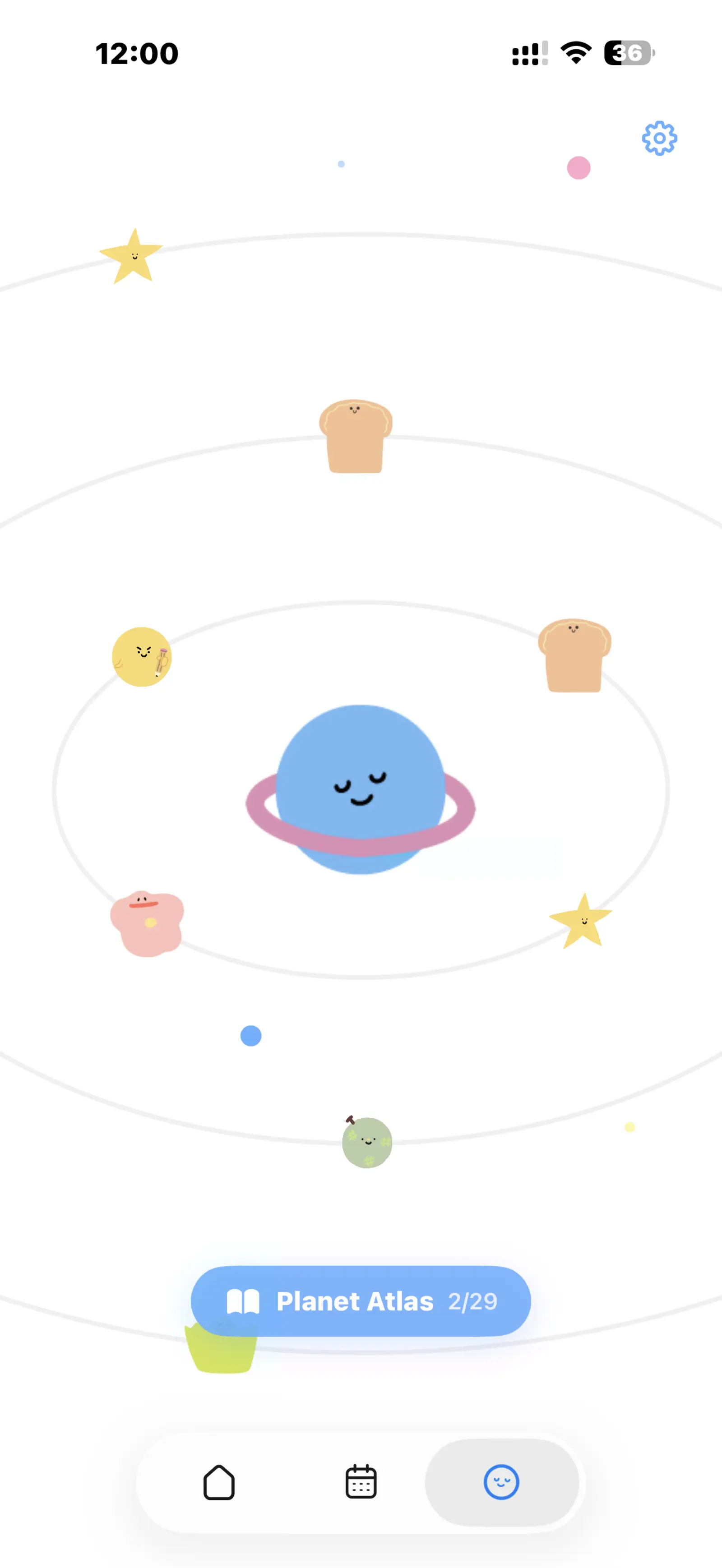
The atlas and the universe show the same collection, but they answer different questions.
If you want to find a particular planet, inspect a detail, or see which parts of a series you have collected, the atlas gives you an organized view. You can move from one character to another without losing your place.
The universe shifts attention from the individual to the whole. You may not be looking for an answer at all. Sometimes it is enough to see the planets together and notice how the space has changed as you have used the app.
The saved unlock date and associated task add another layer. The same illustration can belong to very different days: a chapter finished, a difficult piece of writing untangled, or a session fitted into the middle of a busy afternoon.
You do not need to turn every visit into a formal review. Opening a detail and remembering what you were working on can be a small pleasure of its own.
Sharing can also mean keeping something for yourself
DottieNote’s sharing features include task completions, new planets, the atlas, and the universe. Each is suited to a different kind of record.
A task card keeps the emphasis on something you finished. A planet card gives a new character the spotlight. An atlas or universe image can show a collection after it has had time to grow.
None of those images has to become a social post. Saving a card to your photos is also a way to keep it. You might want a private record of a finished project, or simply a picture of a character you like.
Before sharing publicly, look over the task names, dates, and other text in the image. A reading goal may be fine to show, while a work project or personal plan may need more care. Choose the information you are comfortable sharing instead of trying to fit everything into one card.
The sharing guide explains the different formats. What connects them is the option to remember a session through something other than a timer total.
A familiar face on your real desk
With Dottie Stickers, a character can also live beside your keyboard or in another familiar place. You no longer encounter it only when you open the app.
The physical sticker and a collected planet have different jobs. A sticker helps you open or start its linked task. A planet belongs to the record of a qualifying focus session. Buying or linking a sticker does not automatically unlock that character in the atlas.
The connection is in the familiar artwork and where you meet it: on your desk before you begin, then in the small universe that grows around your work. If you want the practical setup steps, the NFC focus guide walks through them.
Start with a favorite, not a complete collection
When you first open the atlas, try choosing one planet you like. Notice its pose, read its name, and see what drew you to it. A book, a color, or a quiet expression is a perfectly good place to start.
New planets have eligibility conditions and daily limits. The collection guide explains those rules, so you do not need to keep extending a timer to guess when another planet might appear.
Let the collection grow around the things you want to do, at a pace that fits your days. The next time Little Blue appears, you may remember more than the star it is holding. You may also remember what you were doing when you met.